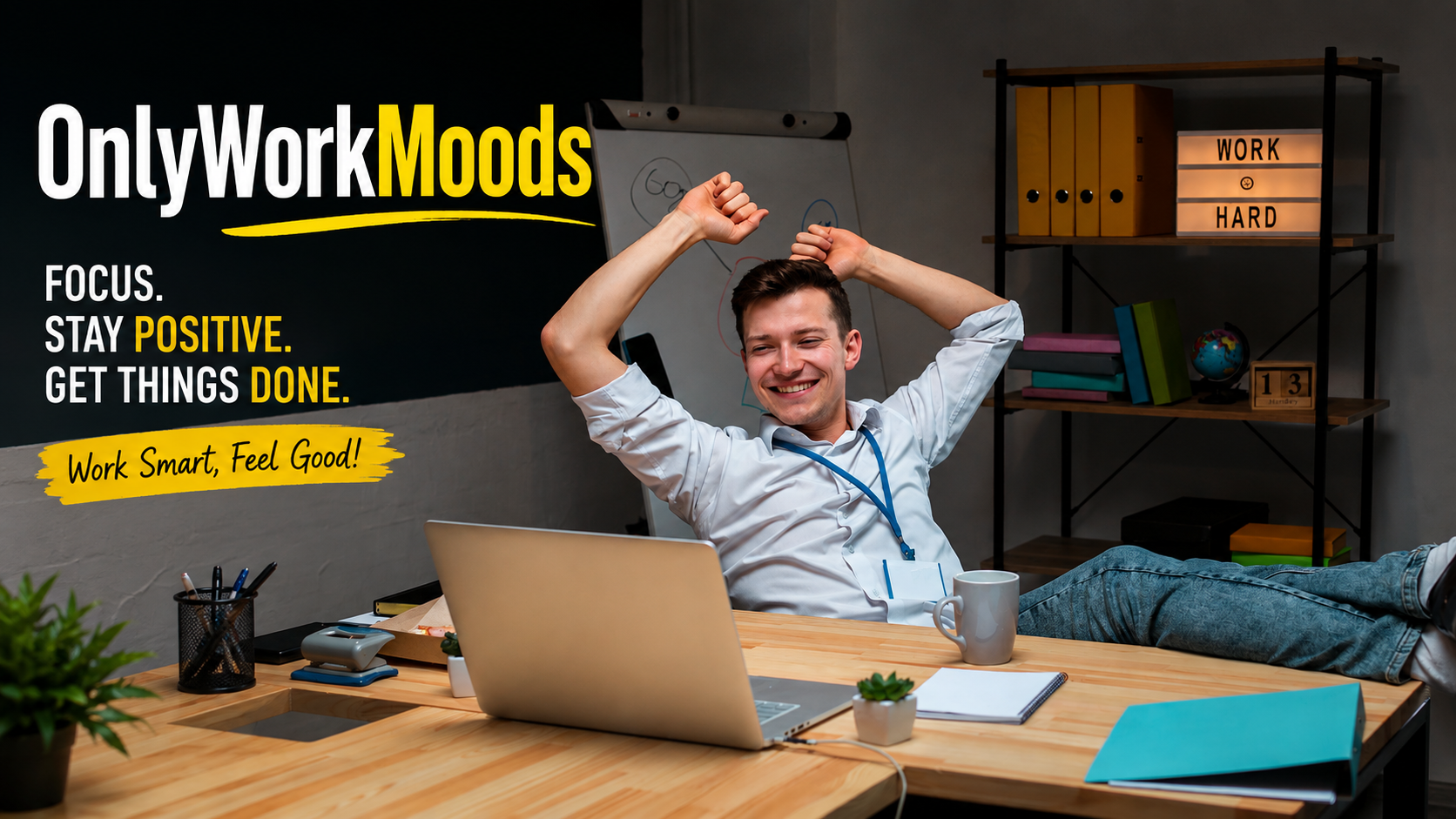
OnlyWorkMoods is the practice of intentionally curating the moods you bring to work — and the name of a growing workplace-lifestyle platform built around that idea. Your workplace mood drives your motivation, productivity, and job satisfaction more than almost anything else you control. If you’ve ever opened your laptop dreading the day, or sat through a meeting running on empty, you already know the problem. Work moods are real. They shape your output, your relationships, and your energy. The good news? You can design them. This OnlyWorkMoods guide shows you exactly how. No fluff, no fake hustle-culture pep talks. Just practical, science-backed ways to show up with the right mood — and keep it.
What Does “OnlyWorkMoods” Mean?
OnlyWorkMoods is an emerging term and trending search topic that blends two ideas: only (as in, your mood is the one thing you fully own) and work moods (the emotional states you carry into your job). Think of it as the opposite of letting your day “just happen” to you.
The concept has grown around a workplace-lifestyle content platform, onlyworkmoods.com, which publishes articles on productivity, motivation, career growth, and workplace well-being. It’s not an app or a mood-tracking tool — it’s a philosophy and a content hub built on one core belief: your mindset at work is your most powerful lever. Gentstyle Magazine.
In short, OnlyWorkMoods = curating the emotional state you bring to your 9-to–5 (or your 7-to–3, or your 11-to-7). It sits at the intersection of workplace motivation, emotional intelligence, and everyday self-care.
Why Your Workplace Mood Actually Matters
Your workplace mood isn’t a soft, “nice-to-have” topic. It’s measurable — and it’s expensive when ignored.
The numbers are stark. Gallup’s State of the Global Workplace 2026 found that only 20% of employees worldwide were engaged in 2025 — costing the global economy an estimated $10 trillion in lost productivity Gallup. In the U.S., engagement sits at just 31%, a ten-year low, with 17% actively disengaged Gallup.
Stress is part of the story too. A 2026 NAMI-Ipsos poll found 30% of employees report feeling “very stressed” — up 11 percentage points since 2024 — and 35% say their mental health has hurt their productivity NAMI.
Here’s the flip side: employee mood works in your favor when you manage it. The average employee is only productive about 60% of the workday — roughly 2 hours and 53 minutes of focused work per 8-hour day WorkTime. That gap is mood-shaped. And 63% of U.S. workers say work has a positive impact on their mental health when conditions are right Grow Therapy.
Research backs the connection. A 2025 study on workplace motivation found that public recognition and positive feedback directly boost morale and output Spytska & Stella,Clío. Another found that career development, motivation, and job satisfaction all feed employee performance . And a landmark meta-analysis of nearly 500 studies showed job satisfaction is strongly tied to both mental and physical health .,
Bottom line: your mood at work isn’t a distraction from productivity. It is the productivity.
The Only Work Moods That Help You Win
Not every mood is useful at work. That’s the whole point of only work moods — you choose which emotional states earn a seat at your desk. Here are the five positive work moods worth cultivating:
Table 2 — The 5 Work Moods at a Glance
| Mood | Best For | How to Trigger It |
| Focused | Deep work, writing, coding, analysis | Noise-canceling headphones, a “focus” playlist, one single tab open |
| Curious | Learning, research, problem-solving | Ask “what’s interesting here?”, explore one new angle before judging |
| Collaborative | Meetings, brainstorming, feedback | Open with “how can I help?”, listen first, talk second |
| Resilient | Tough deadlines, setbacks, high pressure | Reframe “this feels difficult” as “this is a challenge,” take a breath, and focus on one small step at a time. |
| Grateful | End of day, reviews, team culture | Note one win, thank one person, close the loop |
You don’t need all five at once. You need the right one for the task. A focused mood for deep work. A collaborative mood for brainstorming. A resilient mood for tough weeks.
The trap most people fall into? Letting one bad mood — frustration, boredom, anxiety — run the entire day. OnlyWorkMoods flips that script. You name the mood, you set the intention, you do the work.
The OnlyWorkMoods Guide: Build a Better Work Mindset
A better work mindset is built, not born. Here’s the mental framework, step by step.
Step 1: Separate your mood from your worth. A bad day at work isn’t a bad life. Detach your identity from your output. This single shift reduces the pressure that poisons your workplace mood.
Step 2: Name your mood before you start. Every morning, pause and ask yourself: “What mindset and mood do I need for today’s work?” Then say it out loud. Naming an emotion is the first step to steering it — it’s a core principle of emotional intelligence.
Step 3: Design your triggers, not your willpower. Willpower fades by 3 p.m. Triggers don’t. Set a playlist that means “deep work.” Use a specific lamp for focus time. Anchor your professional mindset to physical cues.
Step 4: Protect your focus like a resource. Your attention is the raw material of your work mood. Notifications, open tabs, and constant context-switching are mood-killers. Batch your focus time. Guard it.
Step 5: Close the loop. End each day by noting one win. Gratitude isn’t cheesy — it’s a proven mood regulator. A 2023 meta-analysis on work engagement confirms that positive resources and recovery fuel sustained motivation Mazzetti et al.,Psychological Reports.
OnlyWorkMoods Tips: 9 Daily Habits for a Better Work Mood
These work mood tips are small, repeatable, and instantly actionable. Pick two. Start tomorrow.
- Win the first hour. Don’t check email or social feeds before your first meaningful task. Your first 60 minutes set your daily work motivation.
- Move before you sit. Ten minutes of movement — a walk, stretches, anything — primes your brain for focus.
- Eat for energy, not for comfort. Blood-sugar crashes are silent mood saboteurs. Protein in, sugar spikes out.
- Take real microbreaks. Every 90 minutes, step away for five. Your brain consolidates focus during rest, not during grind.
- Tackle one ugly task first. The task you’re dreading is a mood tax. Pay it early, and the rest of the day feels lighter.
- Set a “stop doing” list. Overcommitment is the quiet killer of healthy work habits. Say no to what drains you.
- Make your workspace yours. Light, plants, order. Your environment whispers to your mood all day long.
- Use a shutdown ritual. Close tabs, write tomorrow’s top task, log off. A clean finish protects your evenings.
- Track your energy, not just your time. Notice when you’re sharp and when you slump. Schedule hard work for your peak hours.
Together, these form a productive work routine — the daily scaffolding of OnlyWorkMoods.
Table 3 — Work Mood Killers vs. Boosters
| Mood Killer | Why It Hurts | The Fix |
| Morning email & social scroll | Starts your day reactive, not proactive | Win the first hour with one meaningful task |
| Notifications & context-switching | Fragments attention, spikes stress | Batch focus time, mute non-urgent alerts |
| Sugar crashes & skipped meals | Energy dips → mood swings | Protein-forward meals, steady hydration |
| Overcommitment | Chronic overwhelm, resentment | Maintain a “stop doing” list and get comfortable with saying no to unnecessary tasks. |
| No shutdown ritual | Work bleeds into evenings, poor sleep | Close tabs, write tomorrow’s task, log off |
| Isolation (remote workers) | Loneliness drains motivation fast | Schedule social connection like a meeting |
The OnlyWorkMoods Lifestyle: Work-Life Balance as a Mood Strategy
Here’s the part most productivity advice gets wrong: work-life balance isn’t a reward for good moods. It’s the engine of them.
The onlyworkmoods lifestyle treats your off-hours as mood infrastructure. What you do after work decides how you feel before work.
- Sleep is a mood multiplier. Skimping on sleep makes every work mood harder to reach. Protect 7–9 hours like a meeting you can’t miss.
- Recovery is productive. Rest, hobbies, and time with people you love refill the emotional battery your job drains.
- Boundaries are self-respect. A stress-free workplace starts with you refusing to bring work stress home — and home stress to work.
- Remote workers, listen up. Without a commute to separate “work” from “life,” you need a hard stop ritual. Close the laptop. Close the day.
Table 4 — Your Daily Energy Curve: When to Do What
| Time of Day | Energy Level | Best Work Mood | What to Do |
| First 2 hours | Peak | Focused | Deep work, hardest task, one ugly task first |
| Mid-morning | High | Curious | Learning, planning, research, strategy |
| Early afternoon | Medium | Collaborative | Meetings, brainstorming, feedback |
| Late afternoon | Low | Resilient / Grateful | Admin, wrap-up, review, plan tomorrow |
Culture matters here too. 83% of employees say they stay with an organization primarily because of its culture and the people they work with HR.com. Your mood isn’t only personal — it’s social. Surround yourself with people who lift it.
How to Build Positive Work Moods as a Team
Individual habits get you 80% of the way. The last 20% is positive workplace culture — and you can influence it even if you’re not the boss.
- Praise in public. Recognition is one of the strongest workplace motivation levers researchers have found Spytska & Stella. Name specific wins. Make it a habit.
- Default to “how can I help?” A healthy workplace culture grows through small, consistent acts of support rather than big gestures.
- Normalize honest check-ins. “How’s your energy today?” beats “How are you?” — it invites a real answer.
- Celebrate progress, not just results. Teams that mark small wins sustain improving work mood week after week.
- Kill the gossip loop. Negative talk spreads faster than any virus. Redirect it.
Leaders: your mood is contagious. If you’re the manager, your workplace mood sets the thermostat for the whole room. Model the moods you want to see.
Quick Summary Table
| Question | Fast Answer |
| What is OnlyWorkMoods? | Curating the moods you bring to work, plus a workplace-lifestyle platform |
| Why does my work mood matter? | It drives motivation, productivity, and job satisfaction |
| How engaged are workers globally? | Only 20% worldwide; 31% in the U.S. (10-year low) |
| How much of the day is productive? | ~60% of the workday, ~2h53m of focus per 8h |
| What are the best work moods? | Focused, curious, collaborative, resilient, grateful |
| Fastest mood fix? | Win the first hour, move, take microbreaks, name your mood |
| Who benefits? | Employees, remote workers, freelancers, and leaders |
Key Takeaways
- Your mood is your most controllable productivity lever. You can’t control deadlines or bosses, but you can curate your emotional state.
- The data is on your side. Engagement is at historic lows — which means small mood improvements stand out more than ever.
- Mood is a system, not a feeling. Sleep, movement, environment, boundaries, and culture all feed it.
- Start small. Two habits, one week. Consistency beats intensity.
- Team mood is a team sport. Praise, support, and honest check-ins compound.
FAQ: OnlyWorkMoods Questions People Actually Ask
What does “onlyworkmoods” mean?
It’s an emerging term for intentionally choosing and managing the moods you bring to work — and the name of a workplace-lifestyle content platform (onlyworkmoods.com) focused on productivity, motivation, and well-being.
Is onlyworkmoods.com an app or a mood tracker?
No. It’s a content-publishing website — a blog covering work, productivity, business, and lifestyle topics — not a software tool.
How can I improve my mood at work fast ?
Win the first hour, move your body, take a five-minute break every 90 minutes, and name the mood your work needs before you start.
What are positive work moods? The focused, curious, collaborative, resilient, and grateful states — each matched to the task in front of you.
How do I stay motivated at work all day ?
Don’t aim for all day. Aim for protected focus blocks at your peak energy hours, with real breaks and a shutdown ritual in between.
Does a positive workplace culture actually boost productivity ?
Yes. Recognition, support, and positive environments measurably lift morale and performance — and 83% of employees stay for culture and people, according to.
How do remote workers manage their work moods?
Build a hard stop ritual, separate your workspace from your living space, and schedule social connection — isolation is the biggest remote-work mood risk.
What’s the best morning routine for a good work mood ?
Move first, eat protein, skip the phone, and complete one meaningful task before checking email. That’s the whole secret.
Final thought
OnlyWorkMoods isn’t about pretending to be happy at work. It’s about being deliberate instead of reactive. Pick the mood, build the routine, protect the balance. Your work — and your life — will feel the difference.
Click here for more details.